6 Easy Posture Exercises to Improve Computer Posture
July 9, 2026 By Ashley Orndorff, aka Marketing Geek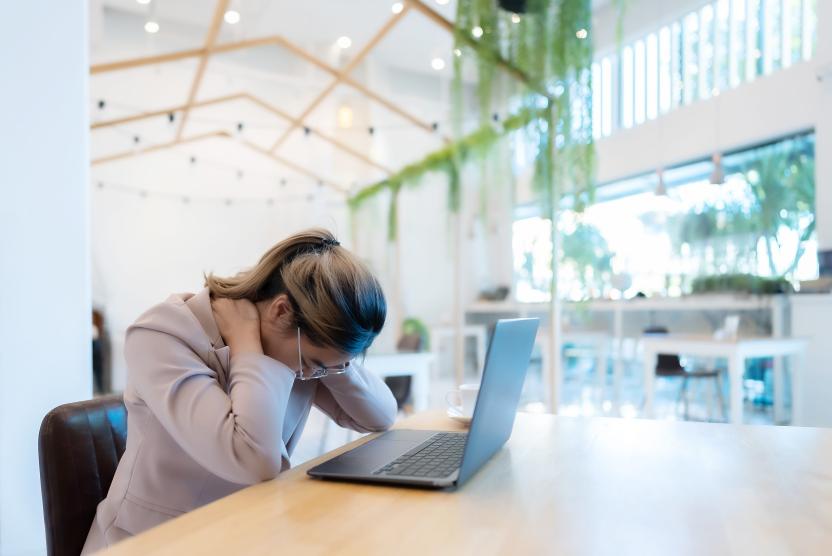
If you work on a computer a lot for your job or just use computers, phones, and other devices a lot, you may spend long periods of time in the same seated position, and likely in a hunched or “flexed” position. Sometimes, you can get so engulfed in solving a problem that, before you know it, you’ve spent two hours hunched over your keyboard and staring at your screens.
Spending long periods of time like this keeps your shoulders forward, chest muscles flexed, and your upper back muscles stretched in a way that is unnatural for humans. This habit can wreak havoc on your posture and create slouched, rounded shoulders, but posture exercises can help. Here are a few easy posture exercises to improve computer posture:
6 Easy Posture Exercises For Beginners
Not taking enough breaks throughout the day to get up and move around is one of the mistakes to avoid when working from home and when working at a desk for long hours. A quick set of posture exercises can be a great way to take a break.
Keep in mind, these will not fix all of your posture issues. But, these programmer posture exercises can help alleviate some of the damage caused by long hours at the desk, whether you are a programmer or not:
- Lying down and deep breathing
- Wall Angels
- Wall Clocks
- Y Raises (“Superman Raises)
- Plank
- High-knee march
1. Lying Down and Deep Breathing
This is likely one of the easiest programmer posture exercises and can likely double as some meditation time, if that is something you want to try. It involves lying down and breathing. It doesn’t get much easier than that!
This posture exercise is designed to stretch your diaphragm and help loosen the upper back, shoulders, and neck. To do this exercise, you will need a flat, comfortable surface. Then, follow these instructions for a deep breathing posture exercise:
- Lie down flat on your back with your knees bent, feet flat on the floor, and head relaxed.
- Tuck your pelvis so your lower back is flat on the floor – you want as little space as possible between your lower back and the floor.
- Keeping your throat and mouth open, breathe in as deeply as you can, filling your abdomen.
- Exhale hard out of your mouth until you are completely out of breath (force the air out; you should hear yourself almost wheezing).
- Repeat steps 1-4 two or three times.
- For a more advanced version, place your hands on the floor above your head as far as you comfortably can.
The video below will walk you through a posture exercise that uses deep breathing and the floor to help improve posture and stretch your diaphragm:
2. Wall Angels
Wall Angels, or scapular Wall Slides, are a good way to strengthen your back and fix rounded shoulders. This exercise is meant to flatten your shoulders, extend your vertebrae, and work the muscles of your upper back.
Wall Angels are great options in general, and especially if you don’t want to get on the floor. Plus, you can do them anywhere you have a clear, sturdy span of wall. There are also a few variations you can try. To do this exercise, you need a flat wall to lean against. Then, follow these instructions for Wall Angels:
Wall Angels, Exercise 1:
- Stand with your back flat against the wall.
- Bend your knees to about 20 degrees.
- Keep your lower back flat against the wall – avoid arching.
- Rest the back of your head against the wall and keep your eyes forward and feet level to the ground.
- Raise your arms to your side at a 90-degree angle to your body with your elbows bent and hands up. Your elbows and the back of your hands should be against the wall.
- Breathe in and slide your hands and elbows up the wall until you feel some tension, breathe out, and lower your arms back to 90 degrees.
- Repeat this motion four to five times.
Wall Angels, Exercise 2:
- Position yourself as you did in steps 1-4 above.
- Imagine a rod going through the center of your chest, and treat this as a turning point.
- While keeping your lower back flat against the wall, tilt your chest, upper back, and arms to one side as if you were rotating on the rod in your chest while sliding against the wall.
- Come back to center and tilt to the opposite side.
- Repeat this motion four to five times per side.
The video below will demonstrate how to do standard Wall Angels:
3. Wall Clocks
Wall Clocks stretch and strengthen your middle and lower trapezius muscles and rhomboids, while supporting your shoulders and rotator cuffs. Like Wall Angels, this is a standing exercise, and all you need is a stretch of empty, sturdy wall. Here is how to perform a Wall Clock:
- Stand facing a wall at an arm’s length away.
- Place both hands on the wall. This is your “home” position.
- Keep your back straight, spine steady, and shoulders away from your ears.
- Alternating left and right hands, move one of your hands away from the “home” position to where the hours would be on a clock.
- Go “around the clock” to hit different positions (up, down, to the side, and diagonal), while keeping your shoulder blades engaged.
- Repeat clock patterns with control, either with a specific number of rounds, for a specific amount of time, or with a specific number of reps.
Wall Clocks With Resistance Bands
If you’d like a bit more stretch and strengthening, you can add a resistance band, either a loop band around your wrists/hands or by looping a resistance band around your hands and holding it with gentle band tension. Then, follow the above instructions while maintaining gentle band tension.
Check out the video below for a visual on how to do Wall Clocks with a resistance band, as well as some simple variations with stepping if you get bored with imaginary clocks:
4. Y Raises (“Superman Raises”)
Y Raises, or “Superman Raises”, strengthen your lower trapezius muscles. Your trapezius muscles pull your shoulders backward. Strengthening these muscles can help correct rounded shoulders. To do this exercise, you need a flat surface to lie on. Then, follow these instructions to perform Y Raises:
- Lie down on the floor, flat on your stomach.
- Place your arms above your head to create a ‘Y’ shape with your torso.
- Point your thumbs up.
- Breathe in, raise your arms off the floor, and squeeze your shoulder blades together.
- Pause for a moment and release back down to the floor.
- Repeat this ten times for three sets.
- Try to work toward strengthening your muscles to perform sets of 20 at a time.
The video below will walk you through how to perform Y Raises correctly:
5. Plank
Planking is a popular exercise with a ton of variations, and for good reason. You don’t have to go crazy with it unless you want to; a simple forward plank provides plenty of benefits and can also improve your posture. Just make sure to keep a correct form and to work up to longer holds if needed. You can also do a modified plank against a wall or using a counter, if you need to.
Here are the instructions for a standard plank:
- Position yourself like you are doing a pushup.
- You can keep your arms in the elevated pushup position or rest your weight on your forearms.
- Make sure your legs remain straight, and your lower back does not sink.
- Keep your neck aligned with your spine and look down at the floor.
- Hold for 30 seconds, or hold for what you can and work up to longer holds over time.
The “Planks for Beginners” video below will walk you through proper form for a good plank exercise:
6. High-Knee March
A high-knee march can be helpful in improving your posture while also strengthening your hip flexors and core. After sitting for a while, this standing exercise is also a good way to get your lower body moving a little bit throughout the day.
- Find a flat surface where you can stand comfortably.
- Stand straight and tall with your feet hip-width apart and relax your shoulders (roll them back and down while lifting your chest).
- Bring your forearms up so your elbows are bent at 90 degrees and your hands are extended in front of you, palms down.
- Bring your knees up one at a time to touch your palms in a slow march.
- You can march for a set time or a set number of repetitions for each side.
- Make sure your chest stays open and lifted, core engaged, shoulders relaxed, neck straight, and eyes forward.
- For a more advanced version, you can increase repetitions, add a twist, or increase speed from a march to a jog.
The short video below will give you a rundown on getting started with proper form and posture for a good high-knee march:
Poor Posture Can Affect More Than You Think
Poor posture has more effects than just aesthetics and neck or back pain. Research has shown that poor posture can also affect:
- Mood
- Stress
- Digestion
- Circulation
- Weight
- Breathing
- Overall Health and Risk of Disease
You can dig into it more in this article about how bad posture affects your health and happiness. It can be difficult to keep an active lifestyle with a job that enables sitting for eight hours a day, and maybe going to the gym just isn’t your thing.
Luckily, there are some in-home posture exercises you can do in 10 or 15 minutes (or fewer!) that can go a long way in helping to improve your posture and maintain a good one. Plus, creating some time to take breaks and do some of these exercises can also help you avoid burnout when working from home.
Take a Stretch Break and Use an Exercise to Help Improve Your Posture
Taking breaks when you need them is a tip for working from home that can help improve your focus and productivity. And, if you include some of these posture exercises in some of your breaks, you can help improve your posture and flexibility, too. These are just a few posture exercises to get you started.
Perform these programmer posture exercises every day, or as many times a week as you can, and you will start to notice more flexibility in your shoulders and upper back. Once again, these exercises are only meant to help alleviate posture damage and are not a complete solution to better posture. Good luck!
View Comments